Saturday, 23 April 2016

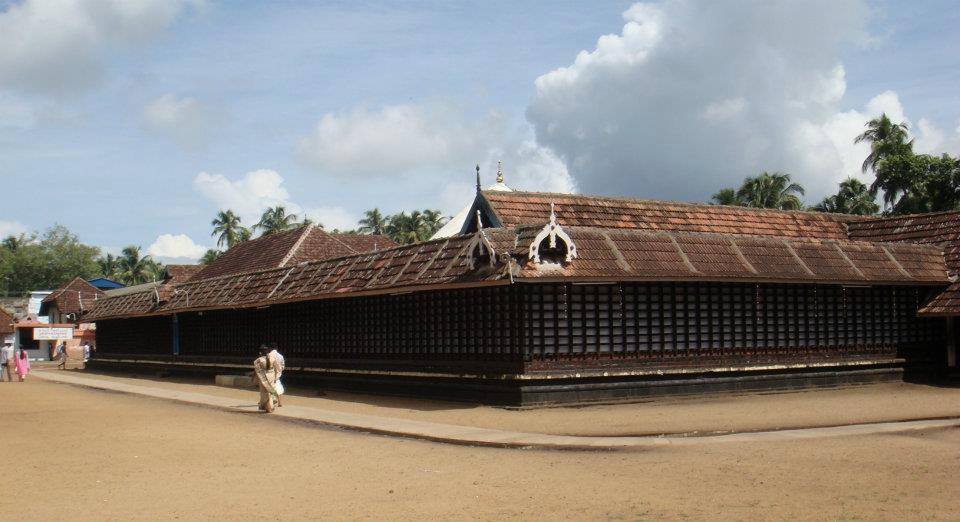
Historical Koodalmanikyam Temple in Thrissur district, Kerala


Historical Koodalmanikyam Temple or Kudal Manikkam Temple / Koodalmanikkam Temple is a Hindu temple which is situated in Irinjalakuda, Trissur district, Kerala state, India. Koodalmanikyam Temple is the temple in India dedicated to the worship of Bharata, apart from Amanakara in Palai- Thodupuzha route, the third brother of Rama. The temple is one of four in Kerala state that form a set called "Nalambalam", each temple dedicated to one of the four brothers in Ramayana: Rama, Bharata, Lakshmana and Shatrughna.


Koodalmanickyam is the Malayalam translation of the Sanskrit word Sangameswara.   There is, however, another talk about the name.   One day the idol was found to give out uncommonly bright  from its forehead.    Unable to identify the source of the brightness, some brought a Quartz (Manikyam) in the possession of Raja of Kayamkulam for comparison.  As they were comparing the brightness of the two, it is said the stone brought from Kayamkulam mysteriously slipped from the hand and merged with the one on the idol.The merging of two manikyamsled to the name ‘Koodalmanikyam’.   Similar brightness is reported to have appeared on the idol once again, much later in 1907.


It is perhaps the only temple in India with Bharatha as the presiding deity.The colourful eleven-day annual festival at the Koodalmanikyam temple is noted for the grand elephant pageantry. The festival falls in during April or May.


The temple is surrounded by four ponds. The largest of the four are Kuttan Kulam, located outside the compound on the eastern side, and Kulipini Theertham, located inside the compound. Kulipini Theertham is believed  to be sanctified by the sage Kulipini Maharshi, who held a great ritual sacrifice. Priests are allowed to take part in the ceremonies after cleansing themselves at the "Kuttan Kulam" outside the temple and then after taking a dip in "Kulipini Theertham" before entering sanctum sanctorum. The pond outside the compound located at the western side,  is called "Padinjare Kulam" and the pond outside the compound located at the southern side is called "Thekke Kulam".  


Getting there


  •      Nearest railway station: Irinjalakuda is about 10 km and Thrissur (Major Station of southern Railway) is about 22 km are the nearest railway stations.
  •      Nearest airport: Cochin International Airport is about 37 km via Salem Kanyakumari Highway.


Wednesday, 6 April 2016

Story of Murudeshwar Temple in Karnataka


Murdeshwara is a town in Bhatkal Taluk of Uttara Kannada district in the state of Karnataka, India. Murudeshwara"' is another name of the Hindu god Shiva. Historical Murudeshwara Temple - Famous for the world's second-tallest Shiva statue.

History.


Once Ravana (King of Lanka) prayed and worshiped Lord Shiva to attain immortality by getting the ‘Atma Linga’ Pleased by his prayers, Lord Shiva appeared before him and asked him what he wanted. By this time Narada had asked Lord Vishnu to change Ravana’s mind. As a result of this plot, Ravana asks for Goddess Parvati instead of atma linga and lord Shiva offers Parvati to Ravana. On the way back to Lanka Narada showing the Kali avatar of Parvati tells Ravana that Shiva has not given him the real Parvathi and that the real Parvathi was in Pathala. Ravana frees Kali and went to Pathala and married Mandodari assuming her to be real Parvati. He then returns to Lanka, where his mother asks him for the Linga. Ravana then realizes that he was tricked started worshiping lord Shiva with much more strong devotion. Lord Shiva appears again and this time, Ravana requests theAtmaLinga as his boon. Lord Shiva agrees to give him the boon with the condition that it should never be placed on the ground. If the AtmaLinga was ever placed on the ground, all the powers would return to Lord Shiva again. Having obtained his boon, Ravana started back on his journey to Lanka.


Sage Narada, who came to know of this incident realised that with the AtmaLinga Ravana may obtain immortality and create havoc on earth. He approached the Lord Ganesh and requested him to prevent the AtmaLinga from reaching Lanka. Lord Ganesh knew that Ravana was a very devoted person who used to perform prayer ritual in the evening every day without fail. He decided to make use of this fact and came up with a plan to take possession of the AtmaLinga from Ravana.

As Ravana was nearing Gokarna, Lord Vishnu blotted out the sun to give the appearance of dusk. Ravana now had to perform his evening rituals but was worried because with the AtmaLinga in his hands, he would not be able to do his rituals. At this time, Lord Ganesh in the disguise of a Brahmin boy accosted him. Ravana requested him to hold the AtmaLinga until he performed his rituals, and asked him not to place it on the ground. Ganesh struck a deal with him saying that he would call Ravana thrice, and if Ravana did not return within that time, he would place the AtmaLinga on the ground.


As predicted, before Ravana could return after completing his rituals, Ganesh had already placed the AtmaLinga on the ground. Vishnu then removed his illusion and it was daylight again. Ravana, realising that he had been tricked, tried to uproot and destroy it; Due to the force exerted by Ravana, some pieces were scattered. One such piece from the head of the linga is said to have fallen in present day Surathkal .The famous Sadashiva temple is said to be built around that piece of linga. Then he decided to destroy the covering of the AtmaLinga, and threw the case covering it to a place called Sajjeshwara, 23 miles away. Then he threw the lid of the case to a placed called Guneshwara (now Gunavanthe) and Dhareshwara, 10–12 miles away. Finally, he threw the cloth covering the AtmaLinga to a placed called Mrideshwara in Kanduka-Giri (Kanduka Hill). Mrideshwara has been renamed to Murudeshwara.


Monday, 4 April 2016

Historical Triprayar Sree Rama Swami Temple, Kerala.


Historical Triprayar Temple, located in Thrissur district is one of the important temples dedicated to Lord Rama. Triprayar temple is located 22 kms south west of Thrissur in between Kodungalloor and Guruvayoor in the mid landmass of Chettuva. The temple is situated on the bank of river Theevra. Theevra river is also called Purayar. Hence this place got the name Thirupurayar (sacred river) and later became Triprayar. There is an interesting legend about the origin of this river. Lord Mahavishnu during his Vamana incarnation visited this place while going to Thrikkakkara and he found no water to wash his legs as the whole place was dry and desolate. Vamana took the water from his kamandalu (a small round vessel used by hindu sages to carry water) and poured the water to wash his legs, that source of water never went dry but kept on flowing as the Thiru Purayar or the Thriprayar (river of divine source) as it is called now. Purayar is also called Nandiyar.


Out of the four idols discovered by fisher men, the Sree Rama idol was the most important. Vakkayil Kaimal decided to install it in Triprayar. It is said that when the image of Rama was discovered and was about to be consecrated, it was divinely ordained that a peacock would appear and mark the exact time for installation. Kaimal and his men waited for a long time for the peacock but it didn't appeared. Apparently the Tanthri (chief priest) installed the idol when a devotee bearing peacock feathers appeared. Soon after the installation the peacock appeared in front of the Sreekovil. It is said that the priests and Kaimal regretted their decision later and to make up for this deficiency the sacrificial stone or the valiya balikkallu was installed at the spot marked by the peacock. Hence the balikkal is said to have the same importance as the deity itself. But this sacrificial stone showed a tendency to spin on its axis. It was Naranathu Bhranthan who fixed it at the spot by hammering a nail through it amidst the chanting of mantras. A mark of a nail can still be seen gives credence to this belief.

In order to prevent any decline in the power of the idol on account of the change in its location Naranathu Bhranthan also arranged to install two goddesses on either side of the deity-Sree Devi on the right and Bhumi Devi on the left. Another legend says that it was Vilwamangalm Swamiyar who is associated with several temples of Kerala, installed the Sree Devi and Bhumi Devi images and shut the Western doors of the temple. One day Swamiyar reached this temple and offered prayers to Lord Rama. During his pooja he noticed that Sree Devi and Bhumi Devi were entering the temple from the western gateway to offer prayers to the Lord. In order to set right the fault in location of the idol he requested them to stay inside the sreekovil. The Goddesses agreed and later Swamiyar installed Sree Devi and Bhumi Devi idols on either side of Rama. He then closed the western doors and left the temple. The western doors of the temple remain shut even today.


The image of Rama (Triprayar Thevar) resembles the Chaturbhuja Vishnu form with four arms, bearing a conch(Panchajanya), a disc (Sudarsana), a bow (Kodanda) and a garland respectively. It is believed that the deity worshipped here possesses some of the aspects of Shiva too. It was after killing the asura, Khara that Sri Rama got both the Shaiva and Vaishnava aspects. Thus Triprayar Thevar is also called Khara Samhara Moorthy. It is also believed that the portrayal of Rama with a garland held in the image's hand is also suggestive of aspects of Bhrahma and hence the deity is said to be a manifestation of the Trimoorthis. The image is adorned with necklaces and other fine jewelry. Images of Sreedevi and Bhudevi are on either side. There is an image of Dakshinamoorthy, in the sanctum facing the south. Dakshinamoorthy is commonly found in Shiva temples. There is also a lamp behind the image which is kept burning all the time. Because of these and also because of the fact that people got relief when troubled by evil spirits chathan-the deity is believed to have a Shiva aspect also.


Ganapathy prathishta is located at the south west corner of the sreekovil. Though there is no separate idol for Rama's best devotee Hanuman, it is believed that his presence is always there at the Namaskara mandapam of the temple. Devotees generally bow before the mandapa imagining the presence of Hanuman there before worshipping Sree Rama. The offering of flattened rice (avil) made from dried paddy is meant for Hanuman. Near the main temple towards the north there is a small shrine of Gosala Krishna. Outside the temple in the southern side of the courtyard there is an Ayyappa (Shastha) shrine. It is believed that the Shastha shrine was located originally at the site corresponding to the temple's sreekovil. With the arrival of Sree Rama, Ayyappa moved to the south in the present location. Now Thriprayar Thevar is the presiding deity of the Arattupuzha Pooram, one of the important festivals of central Kerala. Lord Ayyappa of this temple also participated in this pooram before the installation of Lord Rama. Except Triprayar Thevar, all other participants in this pooram are Sasthas and Bhagavathys of different temples. This also points to the conversion of Shastha shrine to Rama shrine.


Sunday, 3 April 2016

Historical Meenakshi Amman Temple, Madurai.


Historical Meenakshi Amman Temple is the holy temple of hindus located in the city of Madurai in southern India. It is a spectacular yet massive temple of Lord Shiva and Goddess parvati.


That makes this temple different than the others is the fact that both God and Goddess are worshipped together. It is the life line of the country, especially southern India as Lord shiva is the highly worshiped god of the country. It has its foundation way back in the 2500 AD. According to the mythology, Lord shiva visited Madurai to marry Parvati and it has been the sacred abode of Goddess Parvarti since her birth. The wonderful architecture of the place is amongst the seven wonders of the world and the construction is highly minute with great art piece incorporated the walls and pillars of the temple.

Temple History:
According to legend, the sacred Suyambulingam discovered by the king of Gods indira at Kadambavanam, was later enshrined by him in Madurai. The fact that the Lord is seen on the vehicle of Indira in this temple is said to be proof for this.
Many historical evidences of the temple have been found dating back from early A.D. The temple was almost completely destroyed in the year 1310 following the invasion of the Islamic conqueror Malikkapur.As kings who were followers of Islam were noted for their intolerance towards other religions, the invaders destroyed most of the ancient sculptures of the temple.

Thirugnanasambandar the Hindu Saint has mentioned the temple in his songs which go back to early 7th century. The Lord has been described as Alavai Iraivan in his songs.The temple was restored to its pristine glory in the late 14th century when the Hindu Kings came back to power in Madurai.This can also be termed as a new beginning of a new era in the history of the temple, when it was almost rebuilt. The King Thirumalai Naicker played an important role in the construction of the new form of the temple according to records.
The Madurai Meenakshi Amman Temple is now under the administration of the HR and CE department of Tamil Nadu.

Tuesday, 8 March 2016

The Great Temple of Guruvayoor

The Great Temple of Guruvayoor


The Historical Krishna temple in the town of Guruvayoor in Kerala is one of the five famous Krishna\Vishnu temples in India. The others are Jagannath Puri in Orissa, Venkatachalapati in Andhra Pradesh, Nathdwara in Rajasthan and Dwaraka in Gujarat. Of course there are many other famous ones of Vishnu as well as of Krishna but these are considered to be the most popular. Even though the idol in Guruvayoor is that of Vishnu it is still known as a Krishna temple since the boy Krishna is always said to be running around incognito in the temple precincts. Guruvayoor is known as “Bhuloka Vaikunta” or the abode of Vishnu on earth.

History.

The history of the idol goes back to the hoary past to the age of Dwapara when Lord Krishna was alive. His parents were Vasudeva and Devaki. She was the sister of Kamsa, the cruel king of Mathura. They two of them had been great devotees of Lord Vishnu for many ages. After assiduously wooing him for many births, the Lord had manifested himself to them and promised that he would be born as their son for three lives in succession. He promised them liberation at the end of these three births. This was their last birth as Devaki and Vasudeva in the clan of the Yadavas in the city of Mathura and Krishna was born to them as their eighth son. The idol of Lord Vishnu which is found in Guruvayoor is one which had been worshipped by Devaki and Vasudeva and one can easily imagine that it must also have been worshipped by Lord Krishna himself. This is the greatness and glory of this particular idol of Lord Vishnu – that Vishnu himself had done puja to it in his incarnation as Krishna.


The temple is classified as one of the Mahakshetras or “Great abodes of worship”. There are many such in the holy land of India but few which can claim to have all the ten qualifications of a Mahakshetra. The signs are: 1. antiquity (the temple is believed to be over five thousand years old. 2. Presence of records, (it has quite a few copper plates and palm leaf scrolls). 3. Origin in a forest (this place was a forest at one time). 4. Proximity to the sea, (it is near the Arabian Sea). 5. Royal connections (the royal family of the Zamorins of Calicut have been the custodians of this temple from ancient times). 6. Mention in ancient literature (it has been mentioned in the Mahabharata). 7. Grandeur of festivals (the temple has many grand festivals) 8. Situation at an elevation (this is not so but it has a large body of water beside it). 9. Grandeur of sculpture and architecture. (Even though the original temple did not have any great sculptures yet the walls of the inner courtyard has some extraordinary wall paintings made from vegetable dyes, which date to antiquity. The recent construction has plenty of sculptures). The temple now runs a school where this ancient art of wall painting called “chomiru chitram” is taught to young people and reproductions of the originals are made available to devotees. These are the material features which are to be considered in the classification of a Mahakshetra. Of course needless to say the temple should also have special spiritual significance and the presence of numerous devotees who have personally experienced the Lord’s grace.
At the end of his earthly sojourn, Krishna prophesied to his friend and devotee, Uddhava that the island of Dwaraka, which had been his stronghold, would be swept away by the sea, seven days after he left his mortal body. He instructed him to rescue the precious idol of Vishnu which his parents had worshipped, and hand it over to Brihaspati, the guru of the gods who would come to him. After seven days, the island submerged in the sea as foretold by Lord Krishna. Uddhava went sadly to the seashore and saw the idol bobbing up and down on the waves far out in the sea. He begged the wind god – Vayu to bring it closer to him. The wind wafted it gently to the shore and Uddhava picked it up lovingly and cradled it in his arms. As he was wondering how to contact the guru of the gods, he found that Brihaspati himself was walking towards him. Uddhava told him the whole story of how Lord Krishna had instructed him and Brihaspati who knew everything agreed to take it and install it at some special place. He was sure that he would be given further instructions.


Now Brihaspati asked Vayu, the wind god to transport him through the air so that they could choose a perfect spot for the installation. Carrying the precious idol in his hands, Brihaspati was wafted across the sub-continent of India till they came almost to the sea shore to the spot where the present town of Guruvayoor now stands. Looking down Brihaspati saw a beautiful lake filled with lotuses on the banks of which Shiva and Parvati were dancing. He was charmed by the sight and he requested Vayu to float him down. For some time he stood spell-bound by the dancing couple. When they had finished he prostrated to them and begged Shiva to tell him of a perfect spot to install the idol of Vishnu. Shiva said that this was indeed the ideal place. He told him to build the temple right there at one end of the lake where he and Parvati had been dancing. He magnanimously said that he himself would take up residence at the other end of the lake which was known as Rudrathirta. The temple of Mammiyoor to which Shiva shifted still exists. However during the course of time the lake dried up little by little and now only the temple tank adjoining the Guruvayoor temple remains to tell the tale of this ancient lake. The word Guruvayoor has special connotations. It is made up of two words “guru” and “vayu”. Guru means preceptor and vayu is wind. The idol was installed by Brihaspati, the guru of the gods and Vayu, the god of wind and hence came to be known as Guru-vayoor! The word also has an esoteric meaning. It stands for the body of the human being which is the abode of wind. The five pranas or vital breaths are what sustain the body and make it function properly.


Though the idol traces its antiquity to the Dwapara Yuga, the present temple is only about five hundred years old. However the shrine must have existed in some form or other even at the time of the Mahabharata. When the Pandavas departed from this world, they left their kingdom to Arjuna’s grandson, Parikshit who was their only surviving progeny. Parikshit died of snake bite and his son Janamejaya swore to take revenge on the king of snakes and carried out a huge sarpa yajna, or sacrifice of snakes, in which thousands of snakes perished in the flames. For this heinous crime he was cursed by the snakes and became a leper. Forced to leave his palace and his kingdom, he wandered miserably from temple to temple till he came to the shrine of Lord Guruvayoorappan. Here it is said that he did tapasya for many months and was eventually totally cured of his dread disease.


Temple Magazine.

Many cases of cures and miracles have been attributed to Guruvayoorappan. In fact the monthly magazine of the temple describes the personal experiences of many devotees that continue to take place even now. The temple opens at 3 AM and closes late at night very often at 10 PM or even later when there are special functions. One has to queue for hours to get a fleeting glimpse of the charming figure inside the sanctum sanctorum. The Lord is decorated in various ways during the different pujas. Early morning he is shown as a young child wearing only a small red kaupina and various bits of simple jewellery as befitting a child with a peacock feather in his coronet. He holds a ball of butter in his hand. For the next puja at 10 AM he looks a little older. He is fully adult by the noon puja which is the most elaborate. This ornamentation remains on him till the next morning. It is a strange experience of most true devotees that even though the crowds may be great somehow or other they manage to get a close up view of the Lord even though many people have to leave without being able to get inside. One of the striking features of this temple is that the idol has been so placed that it is visible from very far off, way beyond the main temple doors. 

The web master, Arvind Burger being an American would not have been allowed to go inside since the temple is not open to non-Hindus, but in his own miraculous fashion, Guruvayoorappan literally took him by the hand and allowed him to have darshan from inside the inner courtyard without any of the guards noticing his white skin!!